Overview
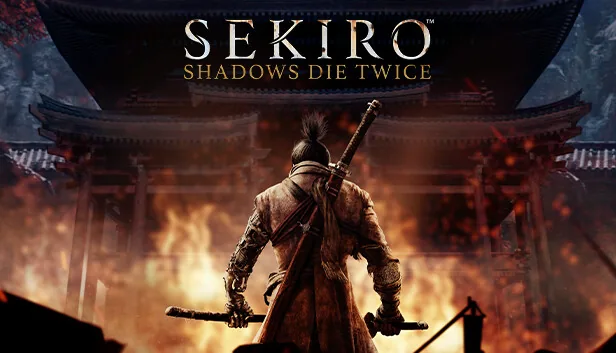
Sekiro: Shadows Die Twice, released on March 22, 2019, represents FromSoftware at its most focused and mechanically precise. Winner of Game of the Year 2019 at The Game Awards, Sekiro strips away the RPG build variety of Dark Souls and replaces it with something rarer: a single, brilliantly realized combat system built entirely around timing, discipline, and the art of the deflect.
Set in a mythologized Sengoku-era Japan, Sekiro trades the Soulsborne formula's freedom for pure mechanical mastery, delivering an experience where every victory feels deeply, personally earned — and where failure teaches rather than punishes.
The Core Loop: Posture, Deflect, Deathblow
Sekiro's combat system is unlike anything FromSoftware — or anyone else — had built before. At its center is the posture mechanic. Every enemy and boss has a Vitality bar (health) and a Posture bar (a measure of their stance stability). Dealing damage depletes Vitality. Deflecting attacks — pressing the Parry button at the precise moment an attack lands — deals posture damage while consuming almost no of your own.
Fill an enemy's Posture bar completely, or reduce their Vitality sufficiently to weaken it, and you open a Deathblow — an instant-kill execution animation. This creates a combat philosophy entirely distinct from Soulsborne: you are not trying to outlast the enemy. You are trying to break them.
The implications ripple through every encounter. In Dark Souls, backing away from an aggressive enemy to manage stamina is a valid strategy. In Sekiro, retreating lets the enemy's Posture recover — you must engage aggressively to win. This inverts the standard Soulsborne defensive mindset and forces a confrontational, rhythmic style of play that feels unlike anything else in action gaming.
Deflecting is the core skill. A perfect deflect makes a distinctive metallic ring, staggers the enemy, and builds posture damage simultaneously. A mistimed block still absorbs damage but doesn't interrupt posture accumulation. A dodge roll avoids damage entirely but wastes the posture-building opportunity. The system rewards precision above all else, and mastering it — progressing from desperate dodging to confident deflecting — is one of the most satisfying mechanical journeys in modern gaming.
The Grappling Hook: Verticality and Ambush
Wolf, Sekiro's protagonist, is a shinobi — not a knight. Accordingly, Sekiro introduces a grappling hook that transforms movement and combat positioning in ways the Soulsborne formula never explored.
Environmental design in Sekiro is built around verticality. Cliffs, rooftops, treetops, and ledges are not obstacles — they are tactical advantages. Flanking an enemy from above to land a free Deathblow before they react is a core gameplay strategy. Escaping a difficult encounter by grappling to a rooftop, breaking line of sight, and recovering is always an option.
The grappling hook also enables stealth approaches that can remove enemies from encounters before combat begins. Crouching in tall grass, waiting for patrols to separate, and landing silent Deathblows on isolated targets provides meaningful agency outside of direct combat — a shinobi toolkit that makes every approach to a new enemy group feel like a small puzzle.
Boss Design: The Finest in FromSoftware's History
Sekiro's major boss encounters are widely considered the best-designed boss fights FromSoftware has ever produced.
Genichiro Ashina — the game's first true boss wall — teaches the deflect system with ruthless efficiency. Players who have not learned the rhythm will lose dozens of times. Players who crack the deflect timing will feel the entire game open before them. This is intentional pedagogy disguised as punishment.
Lady Butterfly demonstrates that Sekiro's bosses are not about damage dealing — they are about patience, reading patterns, and breaking composure.
Gyoubu Oshiba is a spectacular mounted cavalry encounter that uses the grappling hook as a key combat mechanic — a preview of the game's willingness to design encounters that could not exist in any other game.
Owl (Father) is a master-level duel against someone who knows every trick Wolf knows, requiring complete mastery of all tools acquired throughout the campaign.
Isshin the Sword Saint — the final boss — is universally cited as one of the greatest boss fights in gaming history. A three-phase encounter demanding excellence at every skill Sekiro has taught throughout its entire runtime, culminating in a confrontation that feels genuinely worthy of the journey that preceded it.
These are not bosses that punish inadequate grinding or unoptimized gear. They are bosses that punish inadequate skill and reward complete mechanical understanding. The satisfaction of defeating Isshin legitimately, without shortcuts, is comparable to little else gaming offers.
Prosthetic Tools: The Strategic Layer
Beyond the katana and deflect mechanics, Wolf carries a Shinobi Prosthetic arm that can be equipped with interchangeable Prosthetic Tools — mechanical weapons found throughout the world:
- Shuriken Wheel — interrupt distant enemies and extend aerial combos
- Flame Vent — stagger with fire buildup, especially effective against beast-type enemies
- Loaded Axe — crush shields and break enemy posture rapidly
- Firecrackers — stagger beast-type enemies, including one of the game's most memorable encounters
- Finger Whistle — call and redirect animal-type enemies
- Loaded Umbrella — a reflective shield that deflects even the otherwise-unblockable attacks
Prosthetic Tools create strategic depth without the build variety of Soulsborne. Learning which tools counter which enemy types is part of mastering Sekiro's complete toolkit. Many boss encounters have specific tool-based shortcuts for players who have explored thoroughly.
Story: Loyalty, Resurrection, and Sacrifice
Sekiro's narrative is more traditionally structured than any prior FromSoftware title — a recognizable story with a clear protagonist, voiced dialogue, and a comprehensible arc rather than lore fragments requiring interpretation.
Wolf serves Kuro, the Divine Heir of the Ashina clan, whose blood grants the power of resurrection — a power the Ashina warlords, the Interior Ministry, and various factions all seek to exploit. The story explores themes of loyalty versus duty, the cost of immortality, and the nature of death in a world where death can be refused.
Four endings reflect different resolutions: the Immortal Severance ending severs the Dragon's Heritage but requires sacrifice; the Purification ending achieves true healing at greater cost; the Shura path sees Wolf consumed by bloodlust in a dark alternate timeline; and the Return ending — requiring the most thorough exploration — achieves the story's most complete and emotionally resonant resolution.
The writing is economical and effective. Characters like the sculptor Bushinogi, Emma the physician, and Genichiro carry more weight than most action game NPCs. The relationship between Wolf and Kuro forms a genuine emotional core.
What Sekiro Gets Right That Others Don't
Sekiro is uncompromising in a way that serves its design goals completely.
It offers no build variety — and that is correct, because variation would dilute the mechanical focus. It offers no multiplayer — and that is correct, because the skill progression is entirely personal. It offers no difficulty settings — and that is correct, because the satisfaction of victory depends on genuine difficulty.
The game's difficulty adapts to no one. It asks the player to adapt to it. And when adaptation occurs — when the deflect becomes instinctive, when Genichiro's timing is memorized, when Isshin's three phases become readable — the experience is unlike anything else in games.
The Limitations
Sekiro's design philosophy creates real trade-offs:
No build variety means that players who prefer the freedom of Dark Souls or Elden Ring will feel constrained. You cannot respec, cannot choose a different playstyle, and cannot meaningfully outlevel difficult bosses by grinding.
Mini-boss reuse is a genuine issue — several mini-bosses appear multiple times with modestly increased health and damage, which feels repetitive compared to the variety of major encounters.
Limited weapon variety is intentional but jarring for veterans who value Soulsborne's vast armory.
The difficulty wall is steep and absolute. Players who cannot adapt their timing will reach a point where progress stops entirely. There is no workaround.
Final Verdict
Sekiro: Shadows Die Twice is FromSoftware's most mechanically pure game — a single, brilliantly realized combat system executed to near-perfection. It is not the most accessible Soulsborne, nor the most build-diverse, nor the most lore-rich. It is the finest demonstration of precision action combat the genre has produced.
For players willing to meet its demands, it offers a journey with no equal: from frustrated beginner to confident shinobi, from Genichiro to Isshin, from death to Deathblow. Victory never felt so earned.
Score: 9/10 — Precision action at its finest. Isshin alone is worth the price of admission.
System Requirements
PC Requirements
| Spec | Minimum (1080p / Low / 60fps) | Recommended (1080p / High / 60fps) | High (1440p / Ultra / 60fps+) |
|---|---|---|---|
| OS | Windows 7 SP1 64-bit | Windows 10 64-bit | Windows 10/11 64-bit |
| CPU | Intel Core i3-8100 / AMD Ryzen 3 3300X | Intel Core i7-7700K / AMD Ryzen 5 3600 | Intel Core i7-8700K / Ryzen 7 3700X |
| RAM | 8 GB | 8 GB | 16 GB |
| GPU | NVIDIA GTX 760 / AMD Radeon R9 270X | NVIDIA GTX 1080 Ti / AMD RX 5700 XT | NVIDIA RTX 2080 / AMD RX 6800 |
| Storage | 25 GB SSD | 25 GB SSD | 25 GB NVMe SSD |
| DirectX | DirectX 11 | DirectX 11 | DirectX 11 |
Sekiro has very low system requirements compared to other FromSoftware games. Most modern gaming PCs (GTX 1060+) achieve stable 60fps at 1080p High. The game also runs well at 4K/60fps with RTX 3070 or above.
Frequently Asked Questions
Is Sekiro harder than Dark Souls or Elden Ring? Most players find Sekiro harder than Elden Ring due to its lack of build variety, summons, and level grinding — but easier than the first Dark Souls for players who master the deflect system. Elden Ring can be made significantly easier through Spirit Ashes and overleveling; Sekiro offers no equivalent shortcuts.
How long is Sekiro? A first playthrough takes approximately 30-40 hours depending on how quickly the deflect system clicks. Completionists pursuing all endings and optional boss challenges will spend 60+ hours.
Can you play Sekiro without playing Dark Souls first? Yes. Sekiro is a standalone story and the gameplay system is entirely different from Dark Souls. It is actually a reasonable first FromSoftware game for players who prefer action timing over RPG build management.
Does Sekiro have co-op? No. Sekiro is a strictly single-player experience with no multiplayer functionality of any kind — no co-op summoning, no PvP invasion.